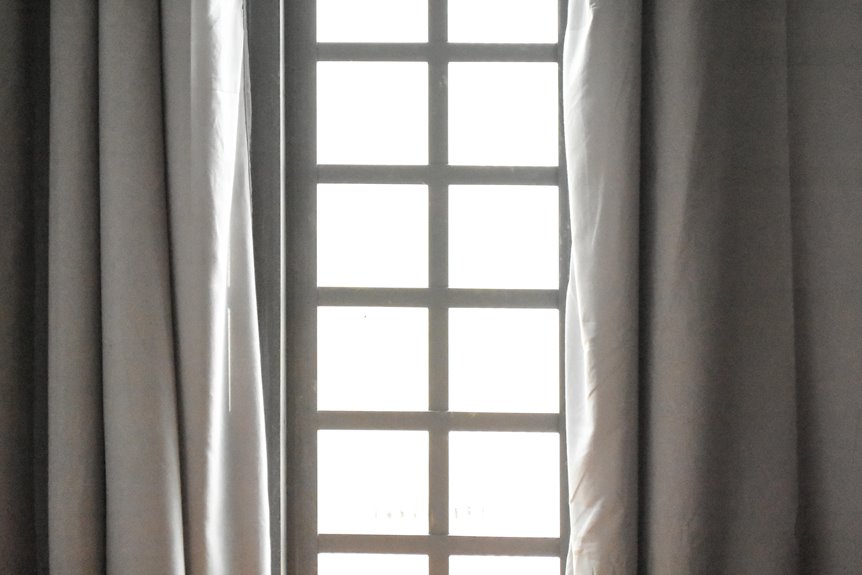
Blackout curtains trap heat through dense, multi-layer fabrics and reflective linings that bounce solar radiation away. You’ll maximize effectiveness by choosing white or off-white backing—it reflects sunlight before it penetrates—and sealing installation gaps with at least 4-inch overlaps at the middle and side edges. Pair thermal lining with polyester blends for superior durability. Layering cellular shades inside blackout curtains outside can cut heat gain up to 60%. Understanding fabric construction and proper placement reveals why some setups fail entirely.
How Blackout Curtains Block Heat: The Science Behind Solar Control

Ever wonder why some curtains keep your room cooler while others barely make a difference?
Blackout curtains work through layered science. Dense, lined fabrics trap air between multiple inner layers, creating insulation that blocks solar radiation before it enters your space. Think of them as your window’s protective shield.
The secret lies in thermal lining with acrylic foam layers. These materials seal the weave, stop airflow, and reflect sun energy before saturated fibers absorb heat. You’re essentially creating a barrier that deflects warmth rather than absorbing it.
The backing color matters too. Light-colored backings reflect sunlight back through glass, minimizing heat absorption. Dark backings do the opposite—they absorb energy you don’t want inside.
This multi-layer approach to solar control makes blackout curtains genuinely effective at keeping heat out, not just blocking light.
Why Blackout Lining Blocks Heat Better Than Fabric Alone
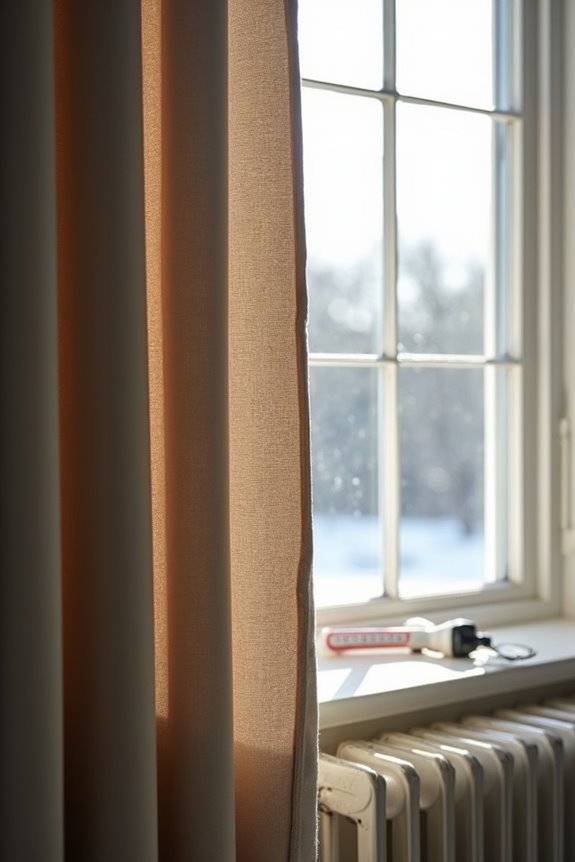
What’s the difference between a curtain that merely darkens your room and one that actually keeps heat out?
Darkening your room and blocking heat are two different things—blackout lining is what actually stops thermal transfer.
The answer lies in blackout lining. Unlike regular fabric, blackout lining contains foam layers that seal your curtain’s weave and stop airflow completely. This matters because standard fabric alone lets heat slip through gaps between fibers.
True blackout lining creates reflective surfaces on its inner side. These surfaces bounce solar radiation away before it penetrates deeper. You’re substantially adding a thermal barrier that reduces heat transfer notably.
The foam also traps a protective air layer behind your curtain. This prevents convective heat exchange between your room and window. Summer heat stays outside. Winter warmth stays inside. That’s the real power of proper lining—it works year-round.
The Color Rule: White Backing Reflects, Black Backing Absorbs
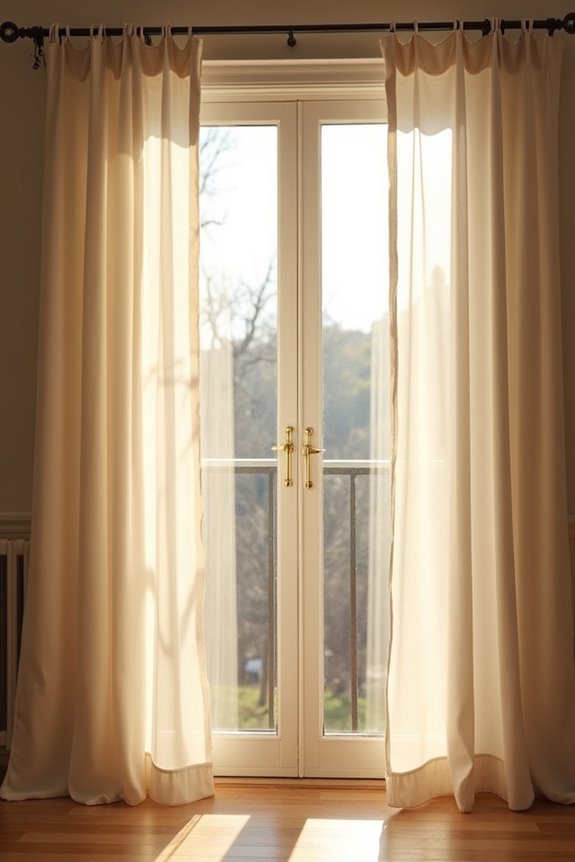
Since color matters more than most people realize, the side of your curtain facing the window should be white or off-white—not dark. White backing reflects solar radiation back through the glass, reducing heat gain considerably. You’re essentially bouncing sunlight away before it enters your room.
Black backing does the opposite. It absorbs energy, creating a hotter air pocket near your window that transfers warmth into your living space. That defeats your entire cooling strategy.
White backing helps reflect sunlight before it even penetrates the curtain weave, maximizing your heat reflection efforts. This simple color choice dramatically improves your energy efficiency. Meanwhile, your room-facing side can stay darker for aesthetics. You get thermal performance and style—without sacrificing either one.
The Chimney Effect and Why Installation Gaps Sabotage Performance
You’ve got your white-backed curtains hung, but here’s the problem: perfect color means nothing if hot air sneaks past your fabric.
The chimney effect describes what happens when sun-heated air between glass and curtain rises, creating hot pockets that escape through installation gaps. This sabotages everything you’re trying to achieve.
Seal the Sides and Center
Curve your rod so fabric hugs the wall, reducing airflow significantly. Overlap curtains in the middle by at least 4 inches—this prevents heat leakage where panels meet.
Block Bottom Gaps
Let your curtain bottom just touch the floor or pool slightly. This seals lower gaps and stops convective heat transfer from rising warm air.
These installation details matter enormously. You’re not just hanging fabric; you’re creating an effective thermal barrier that actually protects your space from heat transfer.
Blackout Curtains vs. Cellular Shades: Which Blocks More Heat?
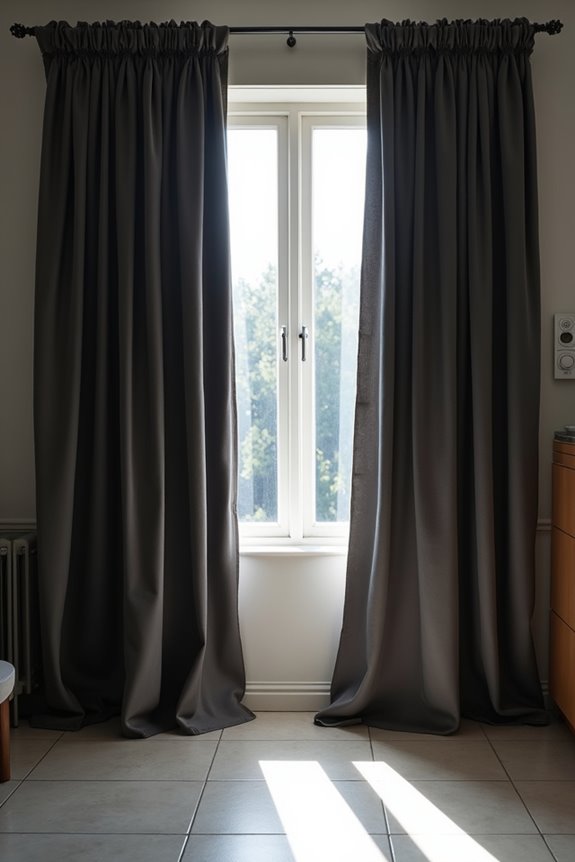
You’re probably wondering which option actually wins the heat-blocking battle, and the answer depends on what you’re measuring. Cellular shades trap air in their honeycomb cells for superior heat control per square inch, while blackout curtains can achieve nearly complete light and heat blocking when properly lined and installed. Here’s the real kicker: you don’t have to choose between them, because layering cellular shades inside your window frame with blackout curtains outside creates maximum heat rejection and light control.
Heat Blocking Performance Comparison
When you’re choosing between blackout curtains and cellular shades, the heat-blocking winner isn’t always obvious. Both options excel at insulation, but they work differently.
Blackout curtains rely on thick fabrics and multiple linings creating air barriers that reflect solar energy. Cellular shades trap air in honeycomb cells, offering superior R-value per square inch. Here’s what matters most:
- Cellular shades outperform blackout curtains for pure heat reduction
- Blackout curtains deliver near-100% light blockage
- White or reflective backing amplifies blackout curtains’ heat rejection
- Cellular structure beats color for heat blocking effectiveness
- Layering both options maximizes overall performance
You’ll get stronger results combining them. Install cellular shades inside your frame, then add blackout curtains outside. This strategy leverages each product’s strengths, giving you total darkness plus maximum insulation throughout your space.
Installation And Sealing Differences
You’re essentially deciding whether your window treatment actually works or just looks good. Proper sealing stops hot air from sneaking around your curtains—the dreaded “chimney effect” that ruins everything.
Making Your Setup Count
You’ll want curtains touching the wall on both sides and overlapping at least 4 inches down the middle. The bottom should just barely touch or pool slightly, sealing those sneaky gaps where heat transfer happens fastest.
Cellular shades work differently. Their honeycomb cells trap air, but improper installation lets light leak at edges—and heat follows right behind it. When sealed correctly, you’re blocking convective heat gain substantially.
Here’s the smart move: layer blackout drapes over cellular shades for maximum heat control. You’re combining their strengths into one powerful defense against summer heat.
What Fabric Blocks the Most Heat: Polyester, Cotton, and Blends
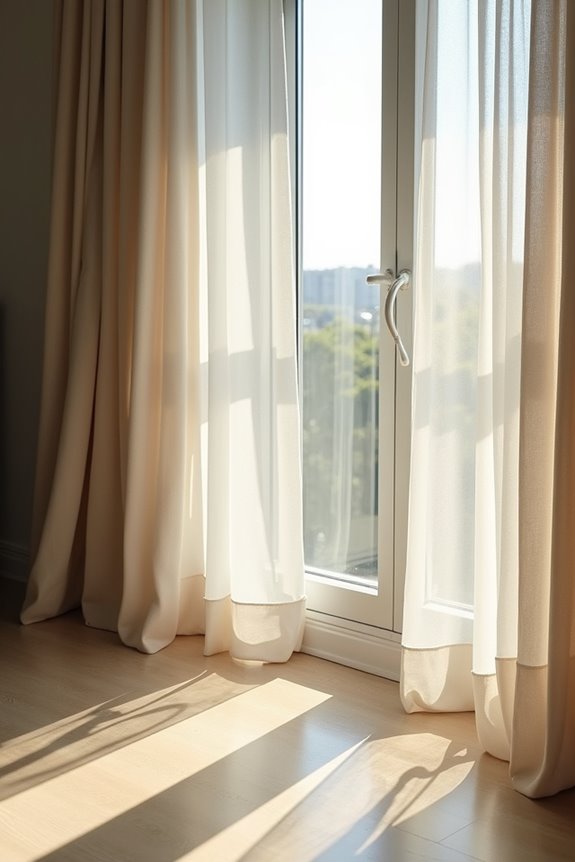
When you’re shopping for blackout curtains, you’ll quickly notice that not all fabrics perform equally when it comes to heat blocking. Polyester dominates the market for heat resistance because it’s naturally durable, resists moisture, and works brilliantly with dense linings that trap air and stop heat transfer. Cotton offers that cozy, breathable feel you might love, but here’s the catch: it’ll need thicker linings or tighter weaves to match polyester’s heat-blocking power, while blends give you the best of both worlds—combining polyester’s durability with cotton’s softness while maintaining serious thermal performance.
Polyester’s Superior Heat Resistance
Because polyester fibers inherently resist heat better than cotton, they’ve become the go-to material for high-performance blackout curtains. You’ll notice the difference immediately when you upgrade to polyester options.
Why Polyester Wins
Polyester delivers superior thermal resistance through several key advantages:
- Multi-layer linings reflect solar radiation effectively
- Dense weaves seal gaps and limit airflow
- Triple-weave construction lowers SHGC values significantly
- White or off-white backing amplifies sun-ray reflection
- Synthetic linings enhance overall heat-blocking performance
You’re getting more than just darkness here. When you choose 100% polyester blackout curtains with thermal linings, you’re investing in cooler indoor temperatures. These panels maintain better opacity than cotton blends while actively pushing heat away from your windows. The result? Your air conditioning works less, your comfort increases, and your energy bills drop.
Cotton’s Natural Insulation Limits
Why does cotton fall short regarding blocking heat? Pure cotton simply doesn’t trap air effectively enough. You’ll find that cotton insulation performs weakly compared to engineered alternatives because it’s a single-layer fabric. Heat transfers right through it unless you add something extra.
| Fabric Type | Heat Blocking | Durability |
|---|---|---|
| Pure Cotton | Low | Moderate |
| Cotton + Thermal Backing | High | High |
| Multi-layer Blackout | Very High | Very High |
When you choose cotton alone, you’re missing critical protection. Cotton allows more heat transfer through its loose weave structure. However, adding thermal backing transforms performance dramatically. That’s where multi-layer blackout fabrics shine—they combine cotton’s comfort with serious heat resistance.
You need dense construction to maximize effectiveness. Pairing cotton with hidden acrylic foam layers gives you the best of both worlds: natural feel plus superior insulation.
Blend Fabrics: Optimal Performance
The real power in heat-blocking curtains comes from smart fabric combinations, not from pure materials alone. You’ll find that blends—polyester-cotton or polyester mixed with other fibers—balance light blockage, thickness, and drape better than single materials can.
Here’s why blends outperform:
- Combine polyester’s durability with cotton’s natural comfort
- Improve heat resistance significantly over pure cotton
- Enable better thermal lining integration
- Support multi-layer construction without excess weight
- Maximize both function and aesthetic appeal
When you choose a blend fabric with thermal lining or multi-layer construction, you’re investing in proven performance. These combinations create the blackout fabric engineered to actually reject heat. You’re not relying on weave density alone—you’re getting science-backed layering. That’s how blends deliver superior heat-blocking results without sacrificing the cozy feel you want.
Sealing Gaps: Side Tracks, Overlaps, and Floor Contact
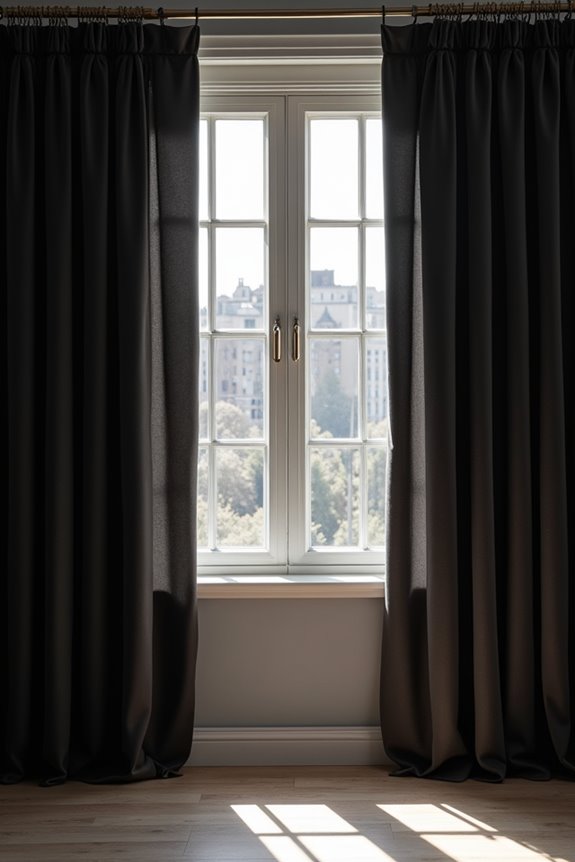
How much heat escapes around your curtains instead of through the fabric itself? You’d be surprised—most energy loss happens through gaps, not the material.
Most heat escapes around curtain gaps, not through the fabric itself—a surprising energy loss many homeowners overlook.
Overlap for Maximum Coverage
You’ll want your curtains overlapping at least 4 inches in the middle. This overlap blocks light and prevents convection loops that pull warm air toward windows.
Side Sealing Strategy
Slip your curtain rod so fabric touches the wall on both sides. You’re essentially creating a seal that stops warm room air from flowing behind the drapes.
Floor Contact Matters
Let your curtain bottom just barely touch the floor or pool slightly. This seals bottom gaps where warm air leaks upward, completing your thermal barrier.
Seal the Top
Don’t forget overlapping above the window frame. You’re blocking top gaps where heat escapes into your room.
How Thermal Rods Block Heat at the Top Gap
Ever notice how heat seems to sneak out from above your curtains, no matter how well you seal the sides? That’s because improper installation creates a top gap where heated air rises and escapes, forming a convection loop that defeats your blackout curtains’ purpose.
Thermal rods solve this problem by curving your fabric to touch the wall on both sides:
- Eliminates the channel where warm room air circulates behind the curtain
- Prevents hot air from rising above the fabric
- Reduces overall heat transfer through your window
- Blocks light leakage at the top
- Creates a complete seal across the entire curtain panel
The Flashlight Test: Is Your Weave Truly Blackout?
So you’ve bought blackout curtains—but are they actually blackout? Here’s how to know for sure. Grab a flashlight and turn off your lights. Shine that flashlight directly at your curtains from inside the room, examining every inch carefully. A true blackout weave stops light completely—no pinpricks, no glowing seams, nothing. If you see even tiny dots of light piercing through, your fabric isn’t truly blackout. That matters because a non-true blackout weave means reduced heat-blocking ability. Dark fabrics alone won’t cut it without thermal lining. Those foam layers seal the weave, stop airflow, and reflect solar radiation before heat saturates your fibers. The flashlight test reveals exactly what you’re getting.
Stack Shades and Drapes for Maximum Heat Control
Now that you’ve verified your curtains are truly blackout, it’s time to amplify their heat-blocking power through strategic layering. You’ll create a formidable barrier against heat transfer by combining multiple window treatments. This multi-layer insulation approach transforms your windows into serious climate-control tools that work smarter, not harder.
Strategic layering transforms blackout curtains into formidable heat-blocking barriers, making your windows serious climate-control tools that work smarter, not harder.
Build your defense with these components:
- Blackout curtains with thermal lining as your outer layer
- Inner cellular or roller shades for additional insulation
- Light-colored, reflective backing facing the glass
- Dark outer layer reflecting solar radiation outward
- Proper rod installation sealing side gaps
Position your drapery rod flush against the wall. Overlap curtains by 4 inches minimum in the middle. Let them just touch or slightly pool on the floor. You’re sealing gaps and preventing the chimney effect that sneaks hot air inside.
What You’ll Save on Energy Bills (And How Fast You’ll Break Even)
How much could you actually save by installing blackout curtains? You’re looking at real reductions in your cooling costs, especially during hot months. Quality lined blackout curtains can cut your heat gain by up to 60% when installed properly. That translates to noticeably lower HVAC usage and smaller energy bills.
Your payback time depends on your climate and window exposure. In sunny, hot regions, higher-quality lined options repay their investment within multiple seasons. You’ll see faster break even if you’re currently running air conditioning heavily. The exact savings vary, but combining blackout curtains with cellular shades inside your frame amplifies results, making your energy savings more substantial and your investment worthwhile faster.
Installation Checklist: A Step-by-Step Heat-Blocking Setup
Follow this checklist for maximum heat-blocking performance:
- Mount rods high and wide, extending 8-12 inches beyond the window frame
- Curve the rod slightly so fabric touches walls on both sides
- Overlap panels at least 4 inches in the middle
- Let fabric barely graze the floor to seal bottom gaps
- Test for light leakage with a flashlight at night
Gaps let warm air circulate between your curtains and walls. You’ll eliminate this chimney effect by sealing everything tight. This installation approach transforms your blackout curtains into genuine thermal barriers, not just decorative dark panels.