You’ll want one curtain ring every 4 to 6 inches across your panel’s width for smooth, even hanging. For a 50-inch panel, that’s roughly 9–10 rings; a 40-inch panel needs about 8–9. Always place end rings 2 inches from each edge to prevent corner sag and curling. Heavier fabrics need closer spacing (around 4 inches), while lighter ones can handle the wider 6-inch gaps. Get these fundamentals right, and you’re set for professional-looking results—though there’s plenty more to master about specific fabric weights and installation techniques.
The Basic Rule: One Ring Every 4 to 6 Inches
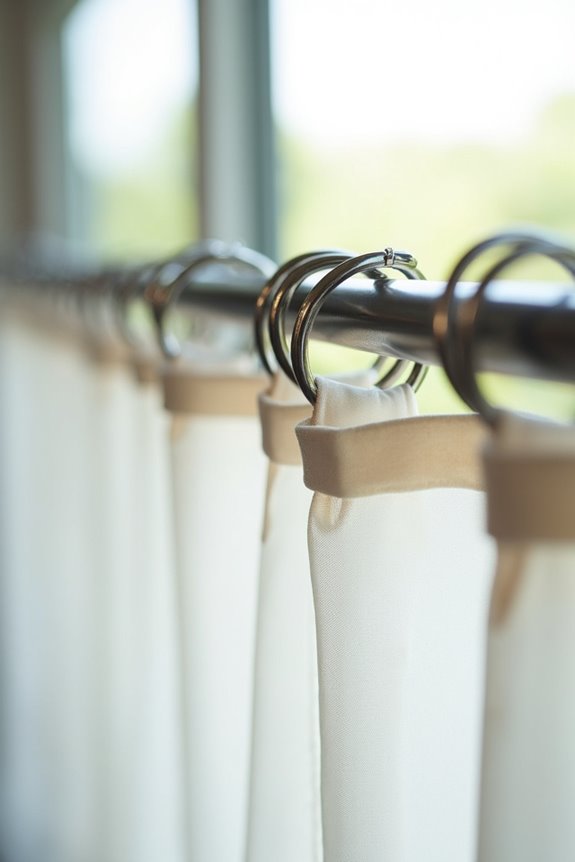
The simplest way to hang your curtains? Follow the spacing standard: place one curtain ring every 4 to 6 inches along your panel’s top. This straightforward guideline keeps your drapes looking polished and prevents frustrating gaps.
Here’s what this means for your per-panel count. A 40-inch panel typically needs 8–10 rings using this spacing rule. The exact number depends on your curtain’s weight and how full you want them to appear.
Think of spacing as your foundation. Closer rings—around 6 inches apart—work best for heavier or lined curtains, preventing unwanted sagging. Lighter fabrics handle wider spacing better. Don’t skip end rings at both edges; they anchor your corners and stop them from curling downward. This simple approach delivers professional results every time.
Panel Type First: Flat vs. Pleated Curtains
You’ll find that flat panels and pleated drapery need completely different ring strategies to hang properly. Flat panels require rings spaced roughly every 57 inches of width, plus extras at back tabs and ends, while pleated drapery typically follows that basic 4- to 6-inch spacing rule you learned earlier. Understanding your panel type first saves you from buying too many rings or too few, ensuring your curtains hang with the fullness and support they actually need.
Flat Panel Ring Placement
Most flat panel curtains benefit from strategic ring placement that keeps fabric hanging smoothly without sagging or bunching. You’ll want to space rings every 57 inches of panel width for optimal support. This measurement prevents the fabric from drooping between attachment points.
Back tabs and end rings serve crucial functions in your setup. Place one ring at each back tab and one on either end of the panel. This strategy maintains edge stability and prevents corners from sagging.
| Panel Width | Ring Spacing | Total Rings | Fabric Type |
|---|---|---|---|
| 50 inches | Every 57″ | 3 | Light |
| 100 inches | Every 57″ | 4 | Medium |
| 150 inches | Every 57″ | 5 | Heavy |
| Two panels | Double count | 8-10 | Any |
Heavier fabrics benefit from closer spacing around every 4 inches for additional support.
Pleated Drapery Ring Requirements
Unlike flat panels that rely on strategic spacing, pleated curtains demand a more methodical approach to ring placement—one ring per pleat, plus additional rings at the outer edges.
You’ll want to understand your specific pleat counts and panel width before ordering rings. Here’s what you’re working with:
- Pinch pleats: One ring per pleat plus two edge rings (no return), or just the pleat count (with return)
- Knife pleats: Eight rings for single-width panels; triple-width panels need approximately 24 rings
- Ring spacing: Distribute rings evenly to prevent sagging and maintain polished drape lines
- Panel width matters: Wider panels require proportionally more rings for balanced support
This methodical ring spacing keeps your pleats crisp and your panels hanging beautifully, ensuring you’ve got the support your investment deserves.
Calculate Curtain Ring Count: A Simple Formula
How do you figure out exactly how many rings your curtains need? Start with this straightforward approach: place one ring every 4 to 6 inches along the top of your panel, then add end rings at both edges for support.
Your panel width determines the total count. A 40-inch panel needs about 8–9 rings. A 50-inch panel typically uses 9–10 rings, with nine being the standard choice. For wider 72-inch panels, you’ll want 11–12 rings.
The math works because even spacing prevents drooping and keeps your curtains hanging smoothly. Heavier or lined fabrics? Stick to the closer spacing—that means more rings supporting the extra weight. Those end rings aren’t optional either; they stop corners from curling and ensure balanced, professional-looking results.
Ring Spacing for Common Panel Sizes (40, 50, and 72 Inches)
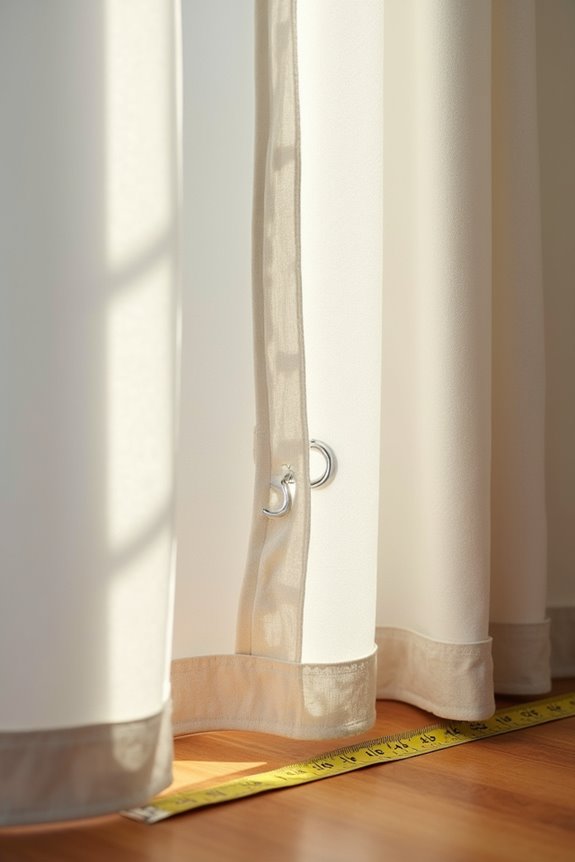
You’ll find that different panel widths call for different ring spacing strategies, and getting this right makes all the difference in how your curtains hang. A 40-inch panel needs 8–9 rings, a 50-inch panel requires 9–10 rings, and a 72-inch panel demands 11–12 rings to maintain even spacing and prevent sagging. Once you’ve determined your ring count, you’ll space them evenly across the panel width—for instance, nine rings on a 50-inch panel create roughly 5.3-inch intervals between each ring.
Forty-Inch Panel Guidelines
When it comes to hanging a 40-inch curtain panel, the math’s actually pretty straightforward: you’ll want somewhere between 7 and 9 rings to keep everything looking polished and evenly spaced.
Here’s what you need to know about panel width and curtain rings:
- Place end rings near each edge to prevent corners from curling or drooping
- Space rings every 4 to 6 inches across your panel width for even distribution
- Choose 8 rings as your sweet spot for most standard 40-inch panels
- Adjust spacing based on curtain weight—heavier fabrics need rings closer together
This straightforward spacing approach ensures your curtains hang beautifully without sagging. You’ll achieve professional-looking results by following these guidelines, giving your windows that polished appearance you’re aiming for.
Fifty-Inch Panel Standards
Moving up to a 50-inch panel, you’re working with a bit more fabric—and that means adjusting your ring count accordingly. For this panel width, you’ll typically need nine to ten rings spaced evenly across the top, plus end rings at both edges.
The standard spacing falls between 4–6 inches apart. This spacing prevents your curtains from sagging while keeping them hanging smoothly. End rings matter here—they stop corners from curling or drooping, maintaining that polished look you want.
If your fabric’s heavier or lined, lean toward the 4-inch spacing instead of 6 inches. This closer spacing provides extra support where your curtains need it most. You’re now equipped to hang your 50-inch panel with confidence and style.
Seventy-Two-Inch Panel Calculations
The 72-inch panel represents your largest standard width, and it demands more rings than smaller panels to handle the extra fabric weight and length. You’re looking at 12–18 rings total, depending on your specific fabric type and fullness preferences.
Here’s what you need to know about ring spacing for this panel width:
- Standard spacing: Place rings every 4–6 inches across your panel width
- Heavier fabrics: Lean toward 15–18 rings to properly support lined or weighted curtains
- Lightweight options: Use 12–14 rings for sheer or lightweight materials
- End placement: Position rings at both edges to prevent corner curling
The weight of fabric matters considerably here. Heavier materials require closer ring spacing to prevent sagging between support points. Don’t skimp on rings—proper support ensures your panels hang beautifully.
Heavier Curtains Need More Rings: Here’s Why
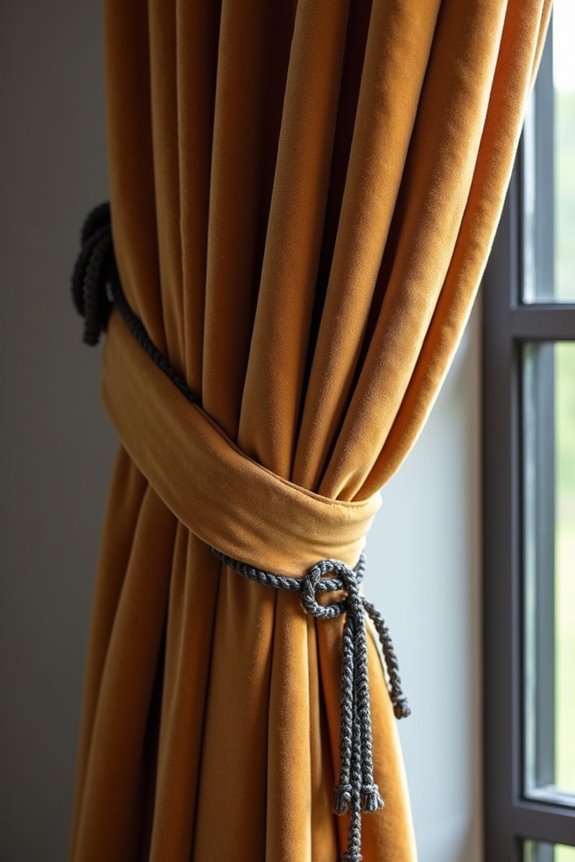
Heavier fabrics demand a different approach to ring spacing than their lighter counterparts, and here’s the simple reason why: weight needs support. When you hang substantial drapes, you’re asking your curtain rings and rod to bear real force. That’s where spacing per panel matters most.
Think of it this way: spreading curtain rings closer together distributes weight evenly across more support points. Instead of seven to nine rings, you’ll want nine to thirteen rings per panel for medium-to-heavy fabrics. Tighter spacing—moving from the standard 4–6 inches toward 3–4 inches—prevents sagging and keeps your drapes looking crisp.
Additional rings reduce fabric strain on hooks and rods, improving glide quality and durability. Your investment in heavier fabrics deserves proper weight distribution. More rings mean better performance.
Lightweight Fabrics: Space Rings 8 Inches Apart
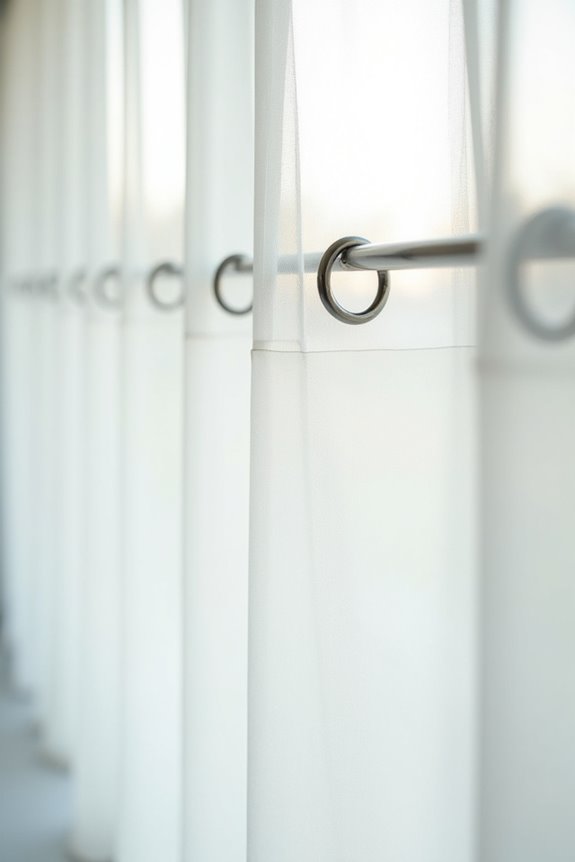
Why should lightweight curtains get different ring spacing than heavy ones? Lightweight fabrics need special attention. They’ll sag and bunch without proper support. You’ll want to space your curtain rings about 8 inches apart along the top edge.
This spacing prevents sagging while keeping operation smooth:
- Divide your panel width by 8 inches to calculate total ring count
- Round up to ensure complete coverage across the fabric
- Place one ring at each edge for balanced hanging
- Distribute remaining rings evenly between end points
Lighter rings work best here. Avoid cramming rings too densely together. Dense spacing adds unnecessary weight near edges, causing flutter and misalignment. Align all rings at identical heights across panels. This creates that cohesive, polished look you’re after while keeping everything gliding smoothly along your rod.
Where Should End Rings Go to Prevent Sagging?
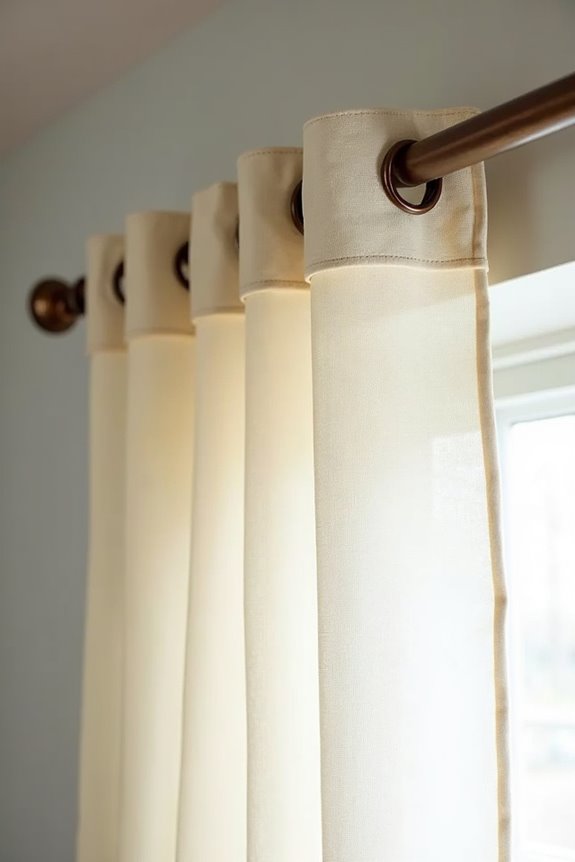
Where you place those end rings makes all the difference in how your curtains hang. Position end rings about 2 inches from each outer edge of your panel. This strategic spacing prevents corners from curling or drooping, which happens when edges lack proper support.
Think of end rings as your curtain’s foundation. They anchor the fabric and reduce edge sag that plagues unsupported panels. Once you’ve positioned those end rings, space your remaining rings evenly across the top between them.
For a 50-inch panel with 9–10 total rings, your two end rings handle the heavy lifting at the edges. The rest distribute weight consistently along the middle section. This balanced spacing approach works beautifully for most fabrics and keeps everything looking crisp and intentional.
Step-by-Step: The Folding Method for Even Placement
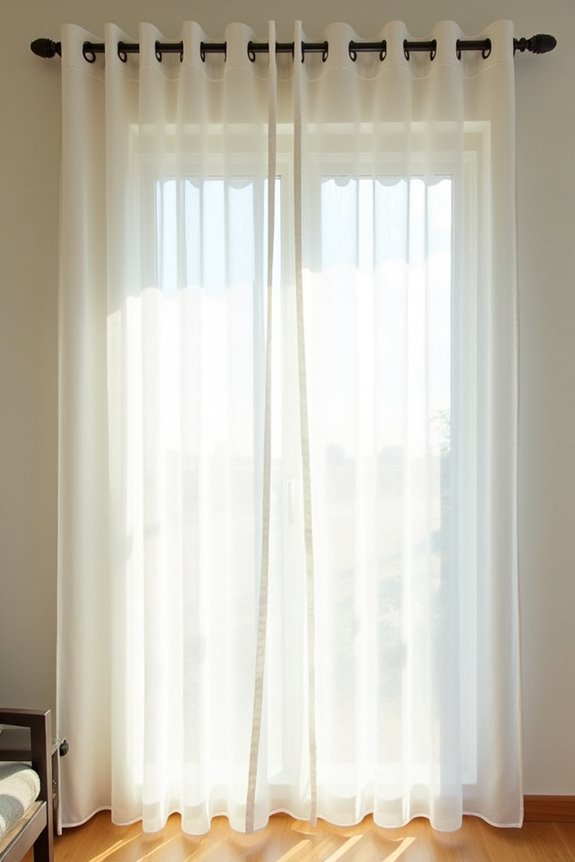
How’d you like to skip the measuring tape and math entirely?
You can achieve perfect curtain ring spacing using a simple folding technique. Here’s your straightforward approach:
- Fold your curtain panel lengthwise in half, then fold again in half
- Fold one final time to create multiple crease lines for reference
- Hold both curtain ends with the folded center aligned
- Place one ring clip on each visible crease across the folds
This folding method eliminates guesswork. You’ll position nine curtain rings with consistent even spacing without calculations. Place clips where creases intersect the top edge, ensuring they sit securely on fabric. When you unfold your panel afterward, you’ll discover perfectly distributed rings ready for hanging. The creases act as your guides, guaranteeing that every ring aligns properly for balanced support.
Test Your Spacing on One Panel First
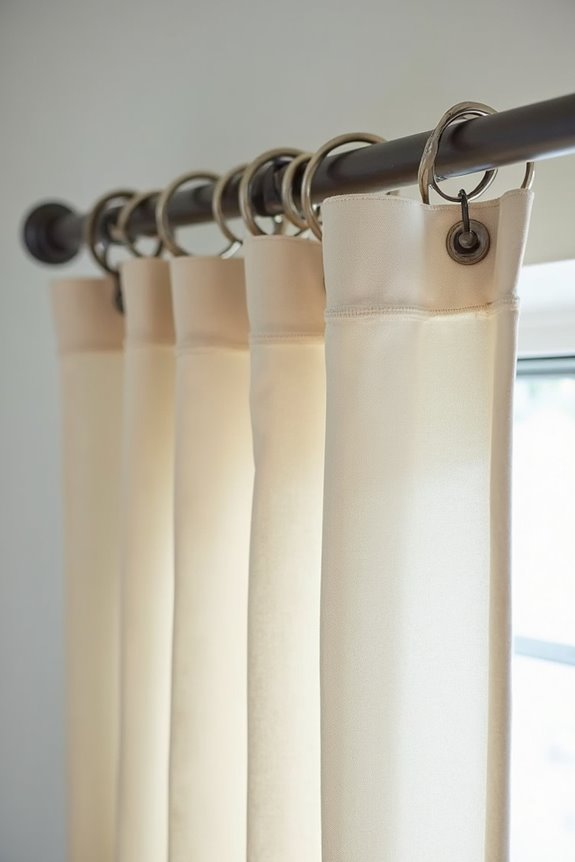
Before you hang all your panels, you’ll want to test your spacing on a single panel first—this smart move saves you time and frustration. Slide your test panel on the rod, adjust the ring spacing as needed, and watch how it hangs to confirm smooth gliding and balanced drape. Once you’re satisfied with how it looks and moves, you’ll know exactly how many rings to use and where to place them on your remaining panels.
Trial Run Before Installation
Why rush into hanging all your curtains when you can test-drive your setup first?
Your trial run prevents costly mistakes. Here’s what you’ll do:
- Hang a single panel using your proposed nine-ring setup
- Space rings evenly at 4–6 inches apart for balanced support
- Position end rings 1 inch from edges to stop curling
- Glide the panel smoothly along the rod to check movement
Watch for sagging or binding during this test. These issues tell you whether your rings per panel count works. Document everything you notice.
Does the fabric drape beautifully? Does it move freely? Does binding occur anywhere?
This trial run confirms your even spacing strategy before you commit to all panels. You’ll adjust ring placement confidently, knowing exactly what works for your space.
Adjusting Spacing For Fit
Now comes the moment where your nine-ring plan meets reality. Unfold your panel completely and slide it onto your curtain rod. Watch how the fabric glides. Does it bunch awkwardly anywhere? That’s your signal to adjust.
You’ll want even spacing between each curtain rings per panel. Measure the distance from your rod’s end to the first ring, then between each subsequent ring. Ideally, gaps should match throughout. If they don’t, slide rings slightly along the rod until your spacing looks uniform.
Test the fit by opening and closing your curtains several times. They should move smoothly without snagging. Stubborn bunching means you need to redistribute rings. Move them outward from the center slightly. This simple adjustment prevents fabric stress and ensures your curtains hang beautifully for years.
Ensuring Smooth Rod Glide
How’ll you know if your ring spacing actually works? Test it first on one panel before committing to all of them.
Here’s your testing approach:
- Place rings at both ends, about 1 inch from edges, then add rings at equal intervals across the 50-inch panel
- Slide the panel smoothly along the rod, checking for resistance or bunching
- Verify that clips align perfectly with the top edge and move freely
- Confirm consistent spacing between curtain rings, typically every 4–6 inches
For heavier fabrics or lined panels, move toward closer ring spacing to prevent sag and ensure reliable panel glide. This test run catches problems before you hang everything, saving frustration and protecting your investment.
Matching Ring Finish to Your Rod and Hardware
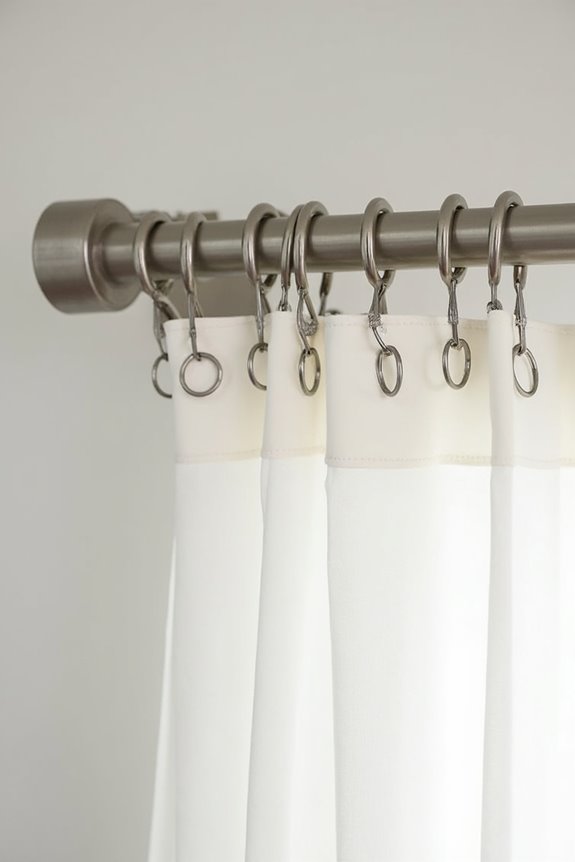
Ever notice how mismatched hardware can make a room feel disconnected? You’ll want your curtain ring finish to match your rod hardware for a polished, intentional look. Bronze rings pair beautifully with bronze rods, while matte black rings complement dark rods seamlessly.
Consider your other hardware too—brackets, hooks, and clamps should echo the same finish family. Popular options include gold, brass, and pewter, each offering distinct style statements.
Compatibility matters beyond aesthetics. Mixing incompatible materials like brass rings on steel rods risks corrosion and staining over time. When you’re uncertain, choose near-identical finishes across all components.
This unified approach creates visual harmony, transforming your window treatment from basic to professionally designed. You’ll feel the difference in how cohesive your space becomes.
Spacing Gaps and Misaligned Ends: Common Installation Mistakes
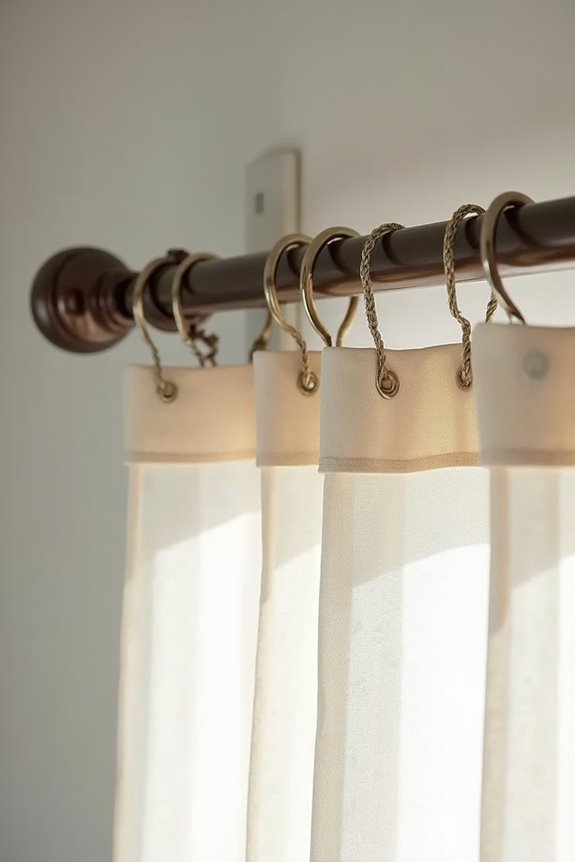
What transforms a neat curtain installation into a lopsided mess? Uneven spacing and misaligned ends. You’ll want to avoid these common pitfalls:
- Uneven gaps between rings cause panels to sag and look asymmetrical across the rod
- Inconsistent end placement creates visibly uneven top edges when rings don’t align with reference points
- Ignoring panel fullness results in too few or too many rings, disrupting smooth gliding
- Loose ring placement lets clips slip and creates puckering along fabric edges
The key? Measure your panel width carefully. Space your rings evenly from end to end. You’ll maintain consistent alignment by marking where each ring sits before installation. Test glide everything on the rod first. This simple step reveals spacing issues before you finalize mounting, ensuring your curtains hang straight and operate smoothly.
How to Troubleshoot Uneven Draping After Hanging
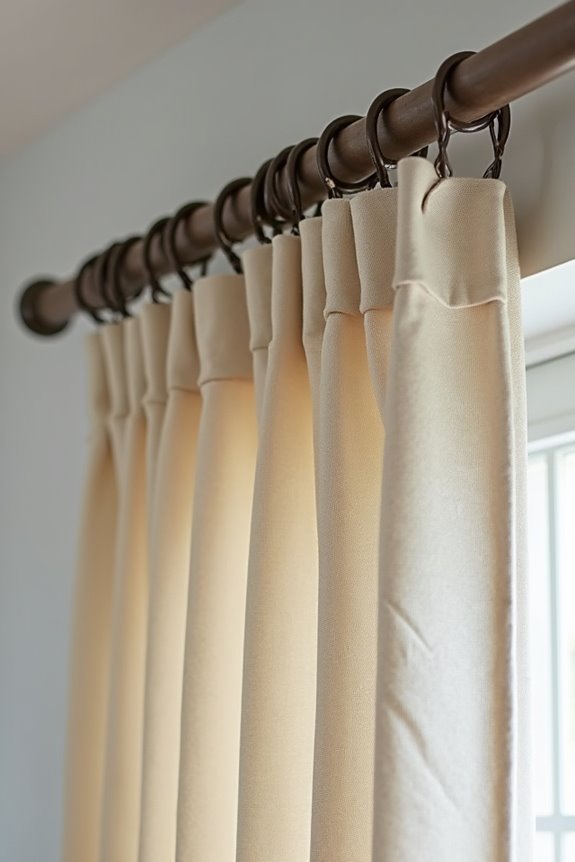
You’ve hung your curtains and they’re up on the rod, but something doesn’t look quite right—one side sags more than the other, or the fabric bunches awkwardly in the middle. Don’t worry. This common issue stems from inconsistent ring spacing or misaligned placement. The solution? Start fresh with equal 4–6 inch gaps between each ring, ensuring every panel has matching ring counts.
| Issue | Cause | Solution |
|---|---|---|
| One side sags | Uneven spacing | Remeasure and redistribute rings equally |
| Fabric bunches | Rings too close | Increase gaps to 4–6 inches apart |
| Lopsided hang | End rings misaligned | Align end rings flush with panel edges |
| Unbalanced weight | Middle rings off-center | Center middle rings directly over folds |
Next, verify end rings align perfectly with panel edges. Middle rings should sit centered over folds for proper weight balance. Test glide smoothly along the rod, then make small adjustments if needed.
When to Call a Professional for Installation Help
Sometimes, even with the best intentions, DIY curtain hanging gets complicated. You’ll benefit from calling a professional when you encounter these situations:
- Ring spacing challenges: You’re struggling to achieve consistent spacing across multiple panels or working with difficult fabrics that demand precision
- Nonstandard ring counts: Your window width or panel fullness requires more than 13 rings per panel to prevent sagging
- Heavy or lined materials: You’re hanging heavyweight drapes needing closer ring spacing and exact measurements for proper support
- Rod compatibility concerns: You’re uncertain about bracket placement, rod length, wall support, or return installation details
Professional installation ensures your curtains hang uniformly throughout your room. Experts handle the technical details you might overlook, delivering that polished, cohesive look you’re after. Sometimes investing in help saves frustration and fabric.