Your 10×10 kitchen remodel cost hinges on ten critical factors: budget tier ($10K–$100K+), cabinet selection (30–40% of costs), appliance choices, countertop materials, layout changes, electrical upgrades, plumbing relocation, flooring, labor rates ($75–$300/hour), and contingency reserves (10–20%). Cabinets alone range from $3,000 stock to $15,000 semi-custom. Moving plumbing costs $5,000–$20,000. Your decisions here compound quickly—understanding each element reveals where you’ll stretch or save your budget most effectively.
Understanding the Cost Tiers: Budget, Mid-Range, and Premium
How much should you really spend on a 10×10 kitchen remodel? Your answer depends on which tier fits your goals and wallet.
Budget remodels run $10,000–$18,000. You’ll get basic updates without major layout changes.
Mid-range remodels cost $20,000–$45,000. This sweet spot balances quality cabinets, solid countertops, and decent appliances while allowing some layout flexibility.
Deluxe/premium remodels start at $60,000–$100,000+. You’re investing in high-end materials and custom designs here.
Per-square-foot pricing clarifies things. Budget averages $75–$150/sq ft, mid-range hits $150/sq ft, and premium reaches $250+/sq ft. For your 100 sq ft space, cabinets consume 30–40% of costs, while labor costs claim 25–50%. These two factors separate budget from premium substantially.
Cabinets: The Largest Cost Factor in Your Remodel
You’ll find that cabinets eat up 30–40% of your entire kitchen budget, making them the heaviest expense you’ll face. Your choices about material—MDF at $100/linear foot, plywood around $200/linear foot, or high-end options hitting $300–$500/linear foot—directly shape your total cost. Quality matters here, and so does timing: locking in pricing mid-2026 before tariffs potentially jump to 50% in 2027 could save you serious money.
Cabinet Quality and Material Selection
What’s eating up nearly half your kitchen remodel budget? Your cabinet materials and finishes. You’ll find three main cabinet materials competing for your attention: MDF cabinets at roughly $100 per linear foot, plywood cabinets at $200 per linear foot, and premium finishes ranging from $300–$500 per linear foot.
Stock cabinets traditionally cost around $3,000, but tariff impact matters in 2026. You’re looking at $4,000–$4,500 post-tariff increases. Semi-custom imports climb even higher, reaching $13,000–$15,000.
Your cabinet costs depend entirely on what you choose. MDF offers budget-friendly options but less durability. Plywood provides better longevity and value. Premium finishes—think rift-sawn white oak in shaker profiles—command higher prices while delivering timeless appeal and perceived luxury that justifies the investment.
Budget Allocation and Cost Breakdown
When you’re breaking down where your 10×10 kitchen remodel money actually goes, one thing becomes crystal clear: cabinets eat up roughly 30–40% of your total budget, making them the heavyweight champion of kitchen expenses.
Your cabinet costs depend heavily on materials. MDF runs about $100 per linear foot, plywood costs roughly $200 per linear foot, and high-end options jump to $300–$500 per linear foot. These price differences directly impact your total project cost.
Layout changes complicate your budget allocation. Relocating sinks or stoves significantly increases expenses compared to keeping existing layouts intact.
Consider refacing versus replacement. Refinishing existing cabinets saves thousands on a 10×10 kitchen, offering substantial savings without full replacement costs.
Appliances: Smart Technology vs. Long-Term Energy Savings
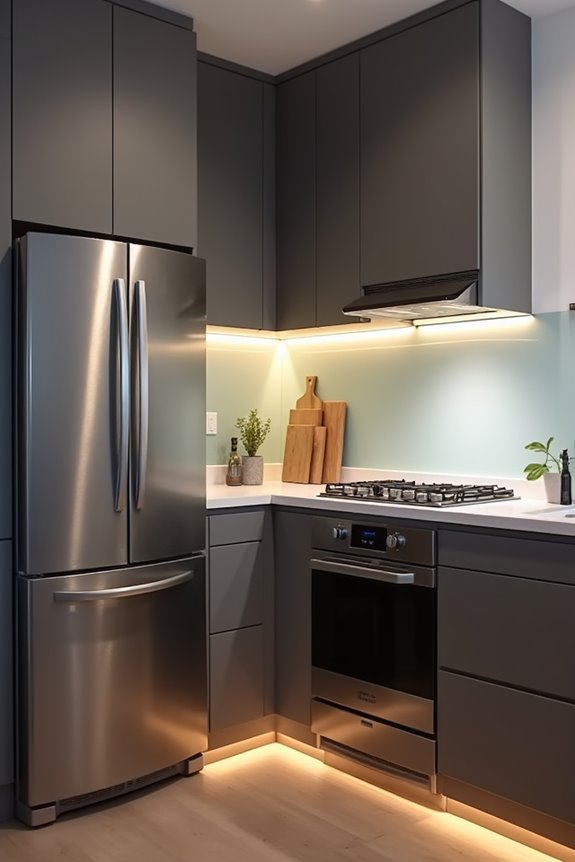
Should you splurge on smart appliances, or stick with reliable, energy-efficient models that won’t drain your wallet today? You’re essentially weighing upfront costs against future savings. Smart technology and energy efficiency aren’t mutually exclusive—you can have both.
A standard appliance package for your 10×10 kitchen runs $3,500 to $15,000. Adding smart features increases that initial investment, but you’ll monitor energy usage remotely and potentially qualify for energy rebates. Consider an induction cooktop upgrade, which requires a dedicated electrical panel ($1,000–$3,000), yet delivers superior efficiency.
Panel-ready appliances add $800–$2,000 to your budget compared to standard models, creating a cohesive design. Think strategically: prioritize smart refrigerators or dishwashers where monitoring matters most. Your long-term utility savings and rebates often justify the premium investment.
Countertops: Material Costs and Installation Complexity
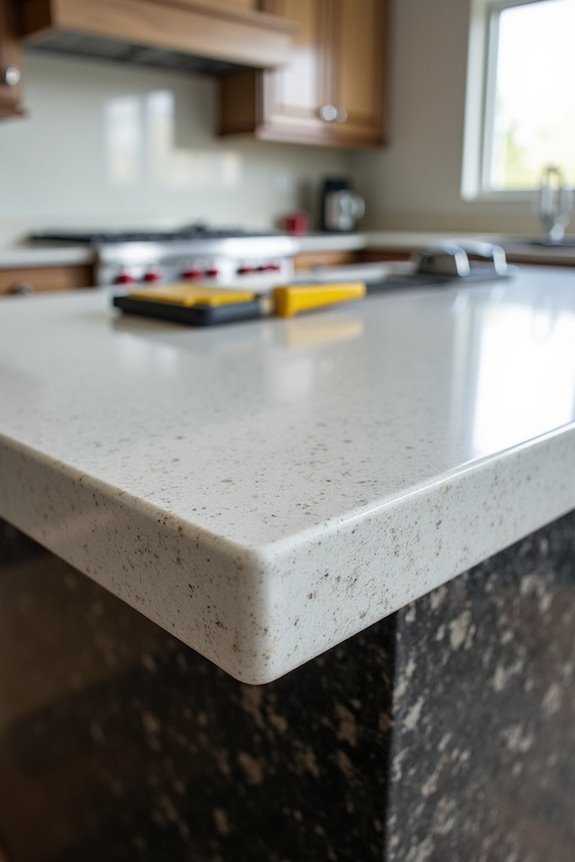
Because countertops cover roughly 40–50 square feet in your 10×10 kitchen, they’ll dramatically shape both your budget and your space’s visual impact. You’ve got solid options here. Porcelain runs $15–$40 per square foot installed, engineered quartz costs $20–$60, and natural stone sits at $30–$75. That square footage matters—a lot.
Your installed price per square foot climbs when you add upgrades. Edge profiles, sealants, and undermount sinks increase labor time. Backsplash integration decisions push costs higher too; full-height slab backsplashes run $50–$100 per square foot installed.
The 2026 trend favors subtle, natural patterns over dramatic veining. You’re choosing durability and style simultaneously. Countertop installation complexity depends on your material choice and customization level, so plan accordingly.
Layout Changes: Why Moving Plumbing and Electrical Adds Thousands
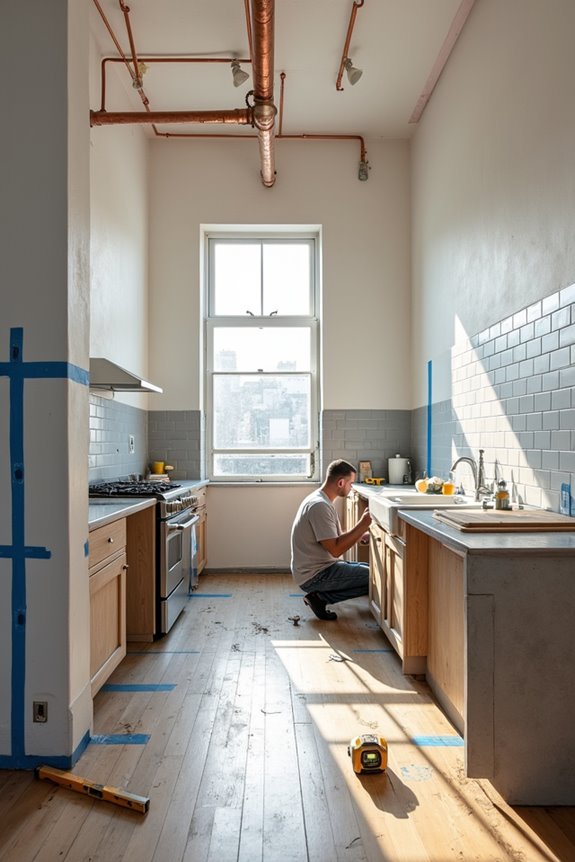
Why do so many homeowners underestimate the true cost of repositioning their sink, stove, or refrigerator? You’re not alone. Most people focus on cabinets and countertops, overlooking hidden expenses.
Moving plumbing or gas lines typically adds $5,000–$20,000 to your 10×10 kitchen remodel. Relocating the sink or stove increases costs by $1,000–$4,000 alone. Why? New plumbing, electrical work, and cabinetry adjustments compound quickly.
Moving plumbing or gas lines can add $5,000–$20,000 to your kitchen remodel costs.
Opening walls for an open-plan layout raises expenses another $2,000–$3,000. Layout changes trigger permits, higher labor demands, and extended project timelines.
You’ll also need cabinet sourcing adjustments and countertop reconfiguration. Keeping your existing layout minimizes risk. Even small repositioning decisions significantly impact your final bill and timeline.
Flooring and Backsplash: Finishing Touches That Add Up
Once you’ve settled your layout and cabinetry, flooring and backsplash choices deserve serious attention—they’re not afterthoughts but budget game-changers. Your flooring costs range dramatically: laminate runs $3 per sq ft, while hardwood reaches $25 per sq ft. For a 10×10 kitchen, expect roughly $1,100 at typical installed rates of $11 per sq ft.
Backsplash expenses vary equally. Your 25–35 sq ft backsplash area accommodates multiple tile options: subway ceramic ($10–$25 per sq ft), glass ($25–$50), or natural stone ($30–$75). Full-height slabs command $50–$100 per sq ft.
Smart budget planning connects these elements. Consider installation methods, finishes and trim, and countertop synergy. Coordinating lighting complements your selections, creating cohesive design that maximizes your total project cost efficiency.
Electrical and Lighting Upgrades: Code Compliance and Costs
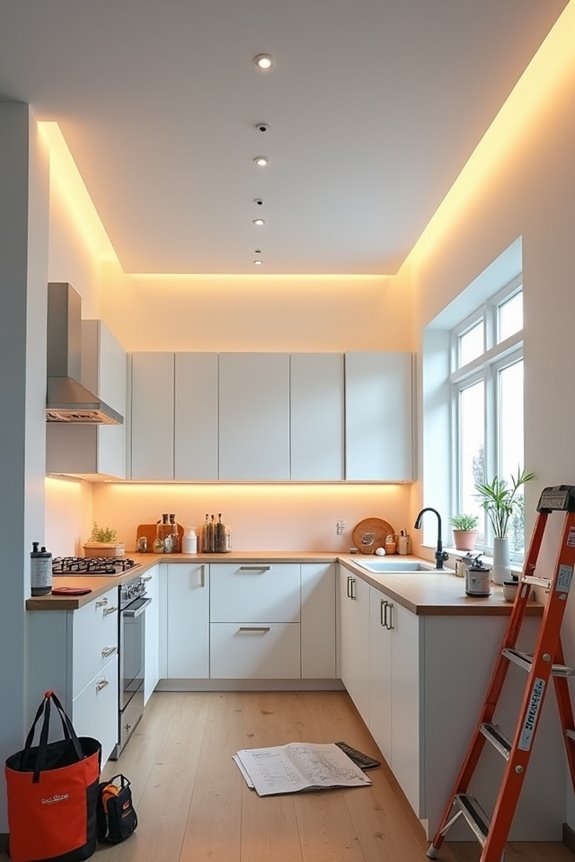
When you’re remodeling your 10×10 kitchen, you’ll need to meet current electrical codes, which means upgrading panels, rewiring circuits, and installing proper lighting—and these requirements add real money to your budget. Your new induction cooktop might demand a dedicated 40–50 amp circuit (costing $1,000–$3,000 for panel upgrades alone), while moving outlets or gas lines runs $150–$350 per outlet and $200–$1,300 for gas relocation. You’ll also want to think about lighting design using the three-layer NKBA approach with tunable white LEDs and dimmers, plus deciding whether you’re relocating under-cabinet fixtures or ceiling lights, since these choices significantly impact both your timeline and your total electrical costs.
Code Compliance Requirements
Because electrical codes exist to keep your kitchen safe and functional, you’ll need to budget for upgrades that meet your local building standards. A dedicated circuit for your 40–50 amp induction cooktop runs $1,000–$3,000, especially if a panel upgrade becomes necessary. You might also install GFCI outlets for safety compliance, adding $150–$350 per outlet in your 10×10 space.
Permits represent another essential cost. Expect $500–$2,000 in permit fees, potentially higher if structural changes are involved. Relocating plumbing and gas lines alongside electrical work can spike costs to $5,000–$20,000 due to labor and permitting demands.
Here’s the smart move: keeping your existing layout dramatically reduces code compliance expenses and timelines. You’ll avoid unnecessary rewiring while still meeting safety requirements.
Electrical Panel Upgrades
Your kitchen’s electrical panel is like the heart of your home’s power system, and upgrading it is often the biggest electrical expense you’ll face during a remodel. Induction cooktops and modern appliances demand serious electrical service upgrades that you can’t skip.
Here’s what you’re looking at:
- Dedicated circuit installation costs $1,000–$3,000 for a 40–50 amp setup
- Additional outlet work runs $150–$350 per outlet, plus gas line adjustments at $200–$1,300
- Permit fees and inspections add $500–$2,000 to your budget
Licensed electricians charge $170–$300 hourly, affecting your timeline significantly. Panel upgrades become a real bottleneck, potentially increasing your total project costs by thousands of dollars depending on your home’s amperage capacity and existing electrical infrastructure.
Lighting Design and Installation
Here’s the catch:
Proper kitchen lighting isn’t just about seeing what you’re cooking—it’s about creating a space that works hard and looks good doing it. You’ll want to follow the NKBA three-layer approach: ambient, task, and accent lighting.
Your Lighting Strategy
LED upgrades are your best bet for energy savings. Recessed lighting handles ambient needs, while under-cabinet LEDs brighten countertops where you prep food. Pendant lighting adds style and focused illumination over islands or sinks.
Installation Costs
Basic fixtures run under $100, but layered designs cost more. Dimmers let you adjust mood and save energy. Here’s the catch: electrical work matters. New outlets or dedicated circuits for high-amp fixtures require rewiring. Expect $1,000–$3,000 for panel upgrades in some projects. Quality lighting transforms your 10×10 kitchen into something special.
Labor Costs: What Contractors Charge and Why
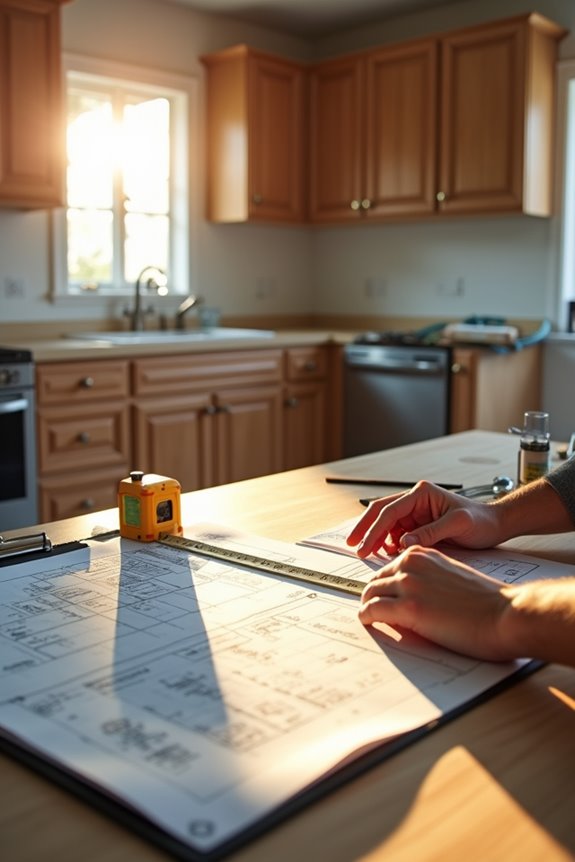
How much of your kitchen remodel budget actually goes to paying workers? Labor typically consumes 25%–35% of your total spending, making it a major line item you can’t ignore.
You’ll encounter three main hiring approaches:
- Full-service general contractors charge 10%–20% coordination fees but handle scheduling and permits
- Direct subcontractors (electricians at $170–$300/hour, plumbers at $75–$150/hour) cut costs but demand your management attention
- Hybrid models combining DIY tasks with licensed professionals reduce expenses by 15%–30%
For your 10×10 kitchen, expect labor costs between $7,500–$9,000. Hiring individual subcontractors adds 10%–20% extra overhead. Your choice balances convenience against savings—full coordination versus hands-on project management. Neither approach is wrong; it depends on your time availability and comfort level.
Finding and Hiring the Right Contractor

You’ll want to verify that your contractor holds proper licensing, insurance, and a solid track record with kitchen projects similar to your 10×10 space. Getting transparent, detailed estimates from at least three contractors helps you spot pricing gaps and understand exactly what’s included—labor, materials, permits, and timelines—so you’re not surprised later. Don’t pick the cheapest bid; instead, compare credentials, past work, and written proposals to find someone who balances experience with fair pricing.
Contractor Credentials And Experience
Because a 10×10 kitchen remodel involves coordinating electricians, plumbers, and other specialists, hiring the right contractor makes all the difference between a smooth project and a costly nightmare. You’ll want someone who understands trade coordination and project management fundamentals.
- Verify licenses and credentials – Confirm your contractor holds current licenses for your state, carries insurance, and maintains bonding that protects you financially.
- Review references from similar projects – Ask specifically about 10×10 kitchen remodels they’ve completed, checking their experience with current standards like NKBA lighting layers and code compliance.
- Examine contract clarity – Ensure your agreement includes detailed scope of work, itemized price breakouts, and clear project timelines that prevent surprises.
These steps reduce delays and change orders significantly.
Transparent Pricing And Estimates
When contractors hand you a quote, what’re you really looking at? You need itemized costs broken down by cabinets, appliances, countertops, and installation. That’s transparent pricing—detailed line-item breakdowns showing exactly where your money goes.
Get multiple contractor quotes to compare. The lowest bid isn’t always your best choice; quality, timing, and warranties matter too. Ask contractors about design services they offer free. This support helps you map cost-conscious solutions before spending anything.
Your contract must clearly define scope of work and include change-order procedures. This prevents scope creep that derails budgets. Verify quotes reflect real cost drivers: layout changes, utility relocations, material tariffs, and lead times. Planning ahead in 2026–2027 gives you better pricing power and realistic timelines for your 10×10 kitchen transformation.
Setting Your Contingency Budget for Unexpected Discoveries
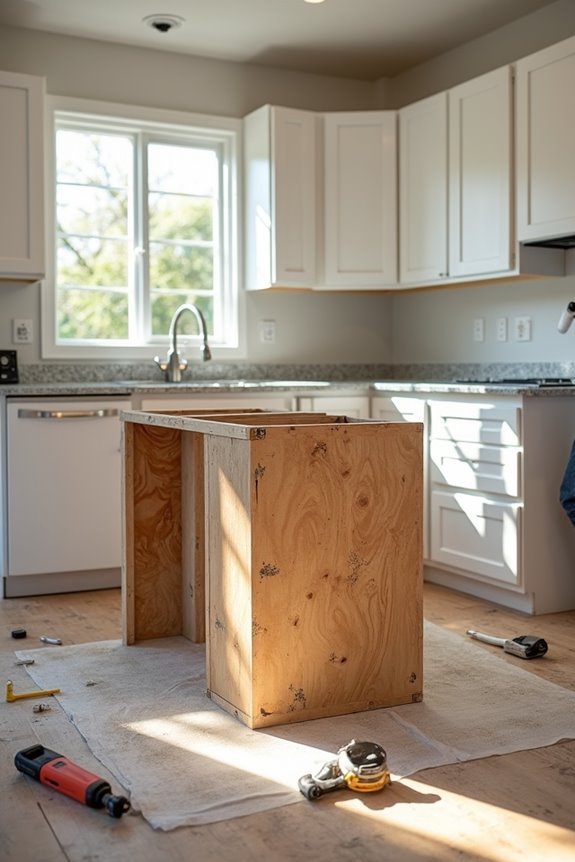
How much extra money should sit in your kitchen remodel fund, just waiting for trouble? You’ll want to reserve 10–20% beyond your base budget. Here’s why that cushion matters:
- Hidden problems emerge during demolition — rotted subflooring, outdated wiring, or corroded pipes force you to pivot quickly and spend more
- Permit fees and code upgrades add $500–$2,000, plus structural fixes that weren’t visible before walls came down
- Utility relocations (plumbing, gas lines, electrical) can jump costs by $1,000–$4,000 depending on complexity
For a $15,000–$30,000 mid-range project, that means stashing $1,500–$6,000 aside. You’re also protecting yourself against price volatility and supplier shifts. Lock in material orders early to stabilize costs and keep your project scope realistic throughout.