
Measure your living room length and width, then multiply to get square footage. A 12×12 room equals 144 square feet; a 14×16 room equals 224 square feet. Use this number to guide blade span: rooms up to 75 sq ft need 29–36 inch fans, 75–175 sq ft need 42–48 inches, and anything over 175 sq ft needs 52–56 inches or larger. Your ceiling height and layout will refine this choice further—and there’s more to consider before you decide.
Start With Your Room’s Square Footage

How do you know what size fan you actually need? The answer starts with a simple calculation. Measure your living room’s length and width in feet, then multiply them together to get your square footage. A 12×12 room equals 144 square feet. A 14×16 room equals 224 square feet. These numbers matter because they determine your ideal blade span.
Once you’ve calculated your square footage, you’ll match it against proven guidelines. Rooms up to 75 square feet work well with 29–36 inch fans. Spaces between 75–175 square feet need 42–48 inch blade spans. Larger rooms demand proportionally bigger fans. This relationship between square footage and blade span ensures your fan circulates air effectively while looking balanced in your space. Getting this calculation right sets you up for success.
Factor In Your Ceiling Height and Mount Type
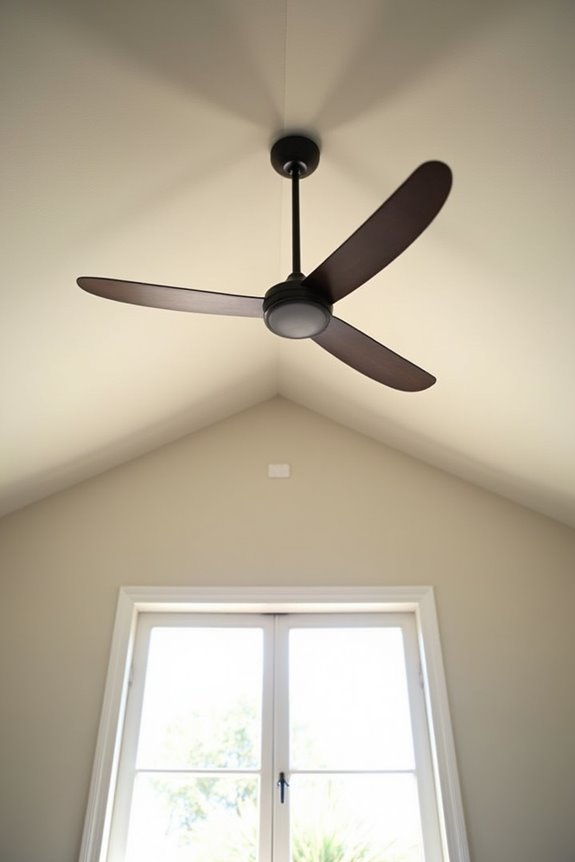
Your ceiling height determines everything about how your fan will work, and you’ll need to pick the right mount type to match it. Low ceilings demand flush or low-profile mounts that keep blades safely out of reach, while higher ceilings benefit from downrods that position blades at the ideal 8–9 feet for maximum airflow. The mount you choose directly affects both your room’s air circulation and how much headroom you’ll actually have.
Low Ceilings Require Flush Mounts
What happens when you’ve got a living room with 8-foot ceilings and you’re eyeing a standard ceiling fan with a long downrod? You’re setting yourself up for problems. That setup crowds your space and creates safety hazards.
Instead, choose a flush-mount ceiling fan—sometimes called a hugger fan. This ceiling fan size keeps blades closer to your ceiling, maintaining that essential 7-foot minimum clearance above the floor. You’ll maintain headroom and avoid that claustrophobic feeling.
Flush mounts also improve air circulation in tight spaces by positioning the fan closer to your room’s center. Skip downrods entirely or use the shortest option available. Keep blade tips at least 18 inches from walls and furniture for unobstructed airflow.
Downrods Work For Higher Ceilings
Downrods become your best friend when you’re working with higher ceilings. They position your fan blades lower, improving air movement throughout your space. Here’s what you need to know:
- Optimal blade height ranges from 8–9 feet above the floor
- Ceiling height over 8 feet requires a downrod rather than flush mounting
- Calculate downrod length by subtracting 9 feet from your ceiling height
- Sloped ceilings may need longer downrods for proper clearance and airflow
- Balance performance and aesthetics by adjusting hang height to match your room
When you install a downrod, you’re making a smart choice. Your fan works better, moves air more efficiently, and looks proportional to your space. The extra investment pays off through improved comfort and visual appeal.
Mount Type Affects Air Movement
The way you mount your ceiling fan matters more than you might think. Your mount-type choice directly influences how effectively your fan distributes air throughout your space.
A downrod mount positions blades lower into your room, creating broader airflow patterns in larger areas. This setup works especially well when you’ve got the vertical space to spare. Flush mounts, meanwhile, sit tight against your ceiling—ideal for snug spaces but less effective for air circulation.
Consider your room’s dimensions carefully. You’ll want at least 18 inches between blade tips and walls. A downrod also helps maintain proper blade height on sloped ceilings, ensuring airflow geometry stays optimal.
The right mount-type enhances both performance and your room’s visual balance. Choose wisely, and you’ll feel the difference.
Match Your Ceiling Fan Size to Room Dimensions

You’ll need to start by measuring your living room’s length and width, then multiply those numbers together to get your square footage. Once you know your room’s total area, you can match it against the standard size guidelines that connect room dimensions to the ideal blade span for your space. This straightforward approach ensures you won’t buy a fan that’s either too small to circulate air effectively or too large and visually overwhelming for your room.
Calculating Your Room’s Square Footage
How do you know what fan size actually works for your space? The answer starts with a simple measurement. You’ll measure your room’s length and width in feet, then multiply those numbers together. That’s your square footage—the foundation for choosing the right blade span.
Here’s what you need to know:
- Measure twice, calculate once for accuracy
- Length × Width = Square Footage formula every time
- Up to 75 sq ft requires 29–36 inch fans
- 75–175 sq ft needs 42–48 inch blade spans
- 175+ sq ft demands 52–56 inches or larger
This straightforward calculation removes the guesswork. You’re not estimating anymore—you’re making an informed decision based on actual room dimensions. Your living room deserves the right fit.
Standard Size Guidelines By Area
Now that you’ve got your square footage locked in, it’s time to match it with the right fan size. Your room square footage directly determines your ideal blade span.
For smaller spaces up to 75 square feet, you’ll want a 29–36 inch blade span. Mid-sized rooms between 75–175 square feet need a 42–48 inch option. Larger living rooms spanning 175–350 square feet work best with 52–56 inch fans or bigger. If your space exceeds 350 square feet, consider installing 60-inch models or using multiple smaller fans strategically.
Remember: these guidelines serve as your foundation, not your final answer. You’ll refine your choice by considering ceiling height and how open your layout feels, ensuring optimal air circulation throughout your living room.
Open vs. Enclosed Rooms: How Layout Changes Your Size Decision

Does your living room flow effortlessly into your kitchen, or does it stand alone behind closed doors? Your room’s layout fundamentally shapes the right fan size for your space.
Open floor plans call for larger fans—52 to 60+ inches—because air travels freely across broader areas. You’re joining a growing group choosing spacious designs that demand bigger solutions. Enclosed rooms benefit from smaller to mid-sized fans (36–48 inches) that maintain visual balance without overwhelming compact spaces.
Consider these layout factors:
- Open layouts allow lower blade speeds, reducing noise while maximizing comfort
- Enclosed rooms need higher airflow efficiency near seating zones
- Clearance requirements differ significantly between open and compartmentalized designs
- Multiple fans work better in sprawling spaces than single oversized models
- Flush mounts preserve precious space in smaller, enclosed living areas
Your layout determines everything.
Rectangular vs. Awkward Spaces: Room Shape Matters

When your living room stretches long and narrow—or twists into an L-shape—a standard ceiling fan placement won’t cut it. Rectangular rooms demand strategic thinking about fan size and placement.
For rectangular rooms exceeding 18 feet in length, consider a larger blade span of 50–54 inches or install two fans. Position your primary fan centered along the width to push air toward seating areas and walking paths effectively. This placement prevents airflow from concentrating only at the center while corners sit neglected and warm.
Awkward spaces require different solutions. Two smaller fans or one larger downrod-mounted unit distributes air across non-symmetric zones more evenly. Skip the temptation to rely on one small fan—you’ll regret those inadequately cooled corners.
Why Large Fans Work Better for Living Rooms

If your living room spans more than 225 square feet, a larger ceiling fan with a 50–54 inch blade span becomes your best investment. You’ll notice the difference immediately—larger fans move considerably more air per revolution, creating better air circulation without forcing your fan to work overtime.
Why Size Matters for Your Space
Here’s what you gain with proper ceiling fan size:
- Broader airflow coverage eliminates stagnant zones throughout your room
- Lower blade speeds deliver comfort while reducing energy costs
- Substantial furnishings appear balanced with appropriately sized fans
- High ceilings paired with downrods optimize air distribution
- Open-concept layouts benefit from uniform airflow across connected areas
A bigger fan isn’t just functional—it’s proportional to your room’s scale, preventing that awkward undersized look.
When to Choose a Smaller Fan Instead

Not every living room calls for an oversized ceiling fan. You’ll want a smaller fan in spaces up to 144 square feet, typically in the 36–42 inch range. This size balances airflow with visual proportion, keeping your room from feeling cramped.
Open-concept layouts benefit from smaller ceiling fans that circulate air without overwhelming the space. Low-profile or flush-mount designs work perfectly if your ceilings sit under 8 feet, preserving safe headroom and maintaining proportions.
Bright natural light or strong secondary lighting also supports downsizing. You’ll need less decorative illumination, so a smaller fan accomplishes your goals efficiently.
When furniture or decor dominates your living room, a smaller fan preserves visual harmony. It avoids crowding your ceiling and keeps everything balanced, making your space feel intentionally designed rather than cluttered.
How to Size a Fan for Open-Plan Living Spaces

Open-plan layouts demand a different approach than smaller, enclosed rooms. You’re not cooling one space—you’re distributing air across multiple connected zones. Here’s what works:
- Choose 52–60 inch fans for spaces larger than 225 square feet
- Center your ceiling fan in the primary area to reach living and dining zones equally
- Use downrods on higher ceilings to position blades 8–9 feet above the floor
- Consider multiple fans if your open space feels too sprawling for one unit
- Account for furniture placement when positioning fans to avoid obstructions and walk paths
Larger blade spans circulate air more effectively across your open-plan living spaces. You’ll notice better comfort throughout connected areas when you prioritize adequate fan size.
Downrod vs. Flush Mount: Which Affects Size More?
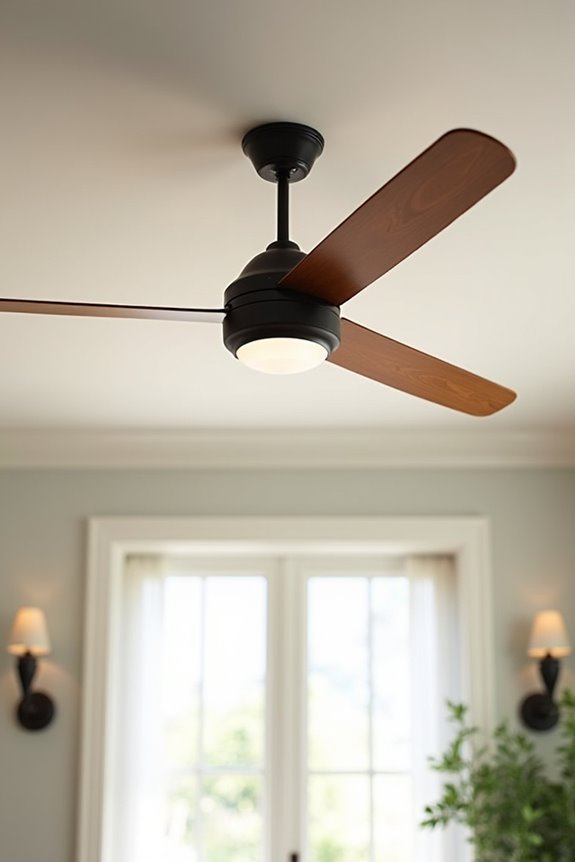
Your choice between a downrod and flush mount fundamentally changes how fan size works in your living room, affecting everything from blade clearance to how well air actually moves through your space. A downrod setup lets you install a larger blade span—often 52 to 60 inches—while keeping the blades at a safe 8–9 feet above your floor, whereas a flush mount works better with smaller 42 to 48-inch blades in rooms under 8 feet tall. The mounting style you pick determines not just what size fan fits, but whether your airflow reaches furniture below or stays trapped near the ceiling line.
Ceiling Height and Blade Clearance
When you’re choosing between a flush mount and a downrod installation, ceiling height becomes your biggest deciding factor—and honestly, it affects your fan size more than you’d think.
Your ceiling height directly determines downrod height and blade clearance. Here’s what you need to know:
- 8-foot ceilings: Use flush mounts to keep blades at or above 7 feet safely
- 9–10 foot ceilings: Install a 4–6 inch downrod for optimal 8–9 foot blade positioning
- Vaulted ceilings: Choose longer downrods or angled mounts to maintain proper clearance
- Blade clearance matters: At least 7 feet above floor prevents head bumping and hazards
- Airflow improves: Correct downrod height enhances air circulation throughout your space
Getting these measurements right ensures your fan works efficiently while keeping everyone safe. Don’t skip this step—it’s foundational to choosing the right fan size.
Airflow Performance and Coverage
Now that you’ve locked in your ceiling height and blade clearance, it’s time to contemplate how your mounting choice actually moves air through your space—because that decision directly impacts what size fan you’ll need.
A downrod mount positions blades lower, spreading airflow across your entire room more evenly. You’ll notice better circulation reaching seating areas and corners. Flush mounts sit tight to the ceiling, potentially creating stagnant air pockets near the top and limiting cross-room movement.
For rooms exceeding 9 feet, downrod fans dramatically enhance reach. In open-concept spaces, larger downrod-mounted models distribute air consistently across different zones. You might need a smaller blade diameter with a downrod setup than a flush mount to achieve comparable coverage. Choose your mounting style strategically—it genuinely shapes your fan size requirements.
Visual Balance and Proportions
Your mounting style dramatically influences perceived fan size. Downrod length and blade span work together to anchor your room’s visual center. Here’s what makes the difference:
- Downrod fans position blades 8–9 feet high in rooms over 9 feet, creating balanced scale
- Flush mounts sit tight to ceilings, appearing smaller in standard 8-foot spaces
- A 52–60 inch fan on a downrod maintains proportionality with tall ceilings and furniture
- The same 52-inch flush mount may feel undersized in open-plan living areas
- Mounting choice affects both actual airflow reach and how anchored your space feels
Your ceiling height determines whether you’ll want that visual breathing room or compact efficiency.
Balancing Airflow and Visual Impact
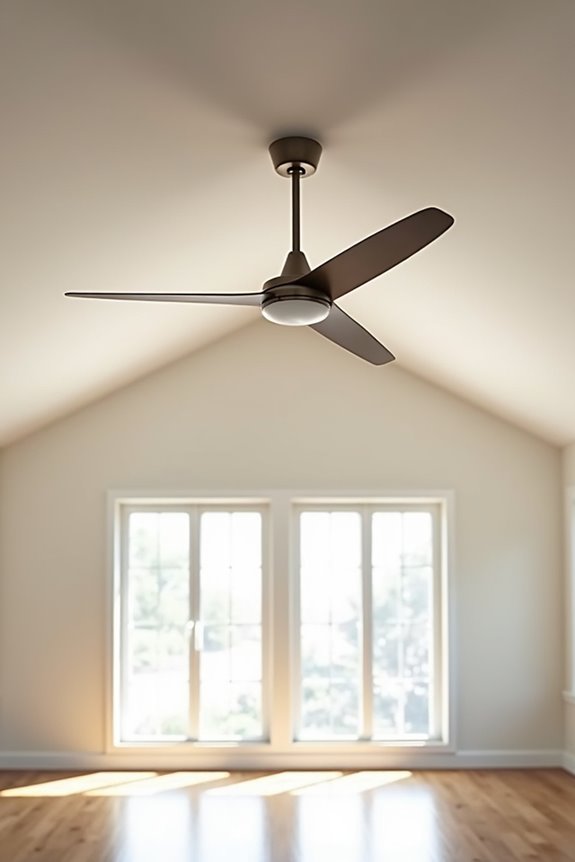
How do you choose a fan that cools your space without dominating the room?
The trick lies in matching airflow to your room’s size while considering visual weight. A 52–54 inch fan works beautifully for standard 225–400 sq ft living rooms. It circulates air effectively without looking oversized or undersized. In larger spaces exceeding 350 sq ft, you’ll need a 60 inch fan or multiple units for even coverage.
Think about proportions carefully. An oversized fan in a compact room creates visual heaviness that disrupts your décor. Conversely, a small fan in a spacious living area leaves corners stagnant. Your goal? Select a size that moves air throughout seating areas while maintaining balanced aesthetics. This approach ensures your fan enhances comfort and style equally.
Common Ceiling Fan Sizing Mistakes to Avoid

What’s the quickest way to waste money on a ceiling fan? You pick the wrong size for your space.
You’re making critical errors when you rely only on room square footage without considering ceiling height, layout, and open spaces. These oversights lead to mismatched blade spans that don’t work for your living room.
Here’s what you should avoid:
- Choosing fans larger than your room needs, which overwhelms spaces under 144 sq ft
- Ignoring ceiling height when selecting downrod or flush mounts
- Installing high-speed fans hoping for better cooling instead of proper sizing
- Forgetting about furniture, walls, and obstructions that disrupt airflow
- Neglecting stagnant corners created by poor placement
Smart sizing means balancing your room’s dimensions with realistic airflow coverage at typical seating heights.
Verify Your Size: Manual Calculation vs. Sizing Calculators

You’ve got two main ways to verify your fan size: do the math yourself or let a tool handle it. Manual calculation means measuring your room, finding the square footage, and matching it to a chart—straightforward but requiring your attention to detail. Digital calculators automate the whole process, factoring in dimensions and sometimes ceiling height to spit out a specific recommendation in seconds.
Manual Calculation Method
Want to skip the online calculators and do the math yourself? You’ll find the process straightforward and rewarding. Start by measuring your living room’s length and width in feet, then multiply them together to get your square footage.
Once you’ve calculated that number, match it against these standard blade span ranges:
- Up to 75 sq ft → 29–36 inches
- 75–175 sq ft → 42–48 inches
- 175–350 sq ft → 52–56 inches or larger
- More than 350 sq ft → 60 inches or multiple fans
Your square footage gives you a reliable starting point. Room height and openness can fine-tune your choice within that range. This hands-on approach builds confidence in your decision, ensuring you’ve picked the right blade span for your space.
Digital Calculator Tools
How quickly can you move from guessing to knowing? Digital calculators transform room dimensions into precise ceiling fan size recommendations instantly. You input your room’s length, width, and ceiling height—tools do the rest.
| Room Size | Manual Range | Calculator Refinement | Ceiling Height Factor | Result |
|---|---|---|---|---|
| Up to 75 sq ft | 29–36 inches | Accounts for obstructions | Standard 8 ft | 32 inches |
| 75–175 sq ft | 42–48 inches | Includes airflow coverage | 9–10 ft | 44 inches |
| 175–350 sq ft | 52–56 inches | Suggests downrod length | 10+ ft | 54 inches |
| Over 350 sq ft | 60+ inches | Recommends mounting type | Vaulted | 60+ inches |
| Mixed layouts | Variable | Cross-checks with rules | Multi-zone | Custom |
These digital calculator tools quickly verify your ceiling fan size against practical guidance. They prompt wall clearance and blade-to-wall distances, ensuring your choice fits your specific living room layout perfectly.
One Large Fan or Multiple Smaller Fans?

The real question isn’t just about size—it’s about coverage. Your living room’s layout determines whether you’d benefit from one powerful unit or several strategically placed fans working together.
Consider these factors:
- Large rooms (225–400+ sq ft) often need a 60-inch fan or multiple smaller ones for even airflow
- Open floor plans justify larger fans to move air across connected zones without dead spots
- Compact layouts favor single, proportional fans to maintain visual balance
- Multiple fans work best when positioned to cover separate seating areas effectively
- Ceiling height and downrods support larger blade sizes better than flush mounts
Think about your actual airflow coverage needs, not just ceiling fan size alone. A single large fan distributes air uniformly across spacious, open areas. Smaller rooms typically thrive with one well-placed unit. Strategic placement matters more than quantity.
How to Shop for Your Sized Ceiling Fan

Once you’ve decided whether you need one fan or several, it’s time to actually pick the right unit for your space. Start by measuring your living room’s square feet, then match it to the blade span guidelines. A 144–225 square foot room typically needs a 42–52 inch fan, while larger spaces demand 50–54 inches or more. Check your ceiling height too. If you’ve got plenty of clearance above 8–9 feet, a downrod helps position blades properly. When browsing, verify the fan sits centered in your room with at least 18 inches from walls. Look for quality motor construction and energy-efficient ratings. Read reviews focusing on noise levels and airflow performance, ensuring you’re buying durability alongside the right size.
Three Final Rules Before You Buy

Before you finalize your ceiling fan purchase, there’s one thing you’ll want to nail down: matching your room’s dimensions to the right fan size and setup.
You’re close to making the perfect choice. Here’s what matters most:
- Measure your room’s square footage first—this determines everything else
- Check your ceiling height to decide between flush-mount or downrod installation
- Consider airflow needs for your specific space layout and usage
- Balance fan size visually with your room’s proportions and décor
- Account for open spaces that may require larger or multiple units
Your room size and airflow requirements work together. A 300 sq ft living room needs different coverage than a 150 sq ft bedroom. Don’t rush this final step. Getting these details right ensures you’ll enjoy efficient cooling and comfortable air circulation for years ahead.